Fifteen stories across two thousand years of Moroccan history, each told by someone your own age who was there. One bronze key passes from hand to hand — from an olive press in Walili to a box at a grandmother’s house in Europe. Invented people, real events; the back of every book says exactly what is true.
Walili, Tariq ibn Ziyad, Fatima al-Fihri, Marrakesh
Launch price through November 30, 2026. After that € 49,99.
All 15 books together for € 34,99 — you buy the series, not a single book.
The books
Book 1
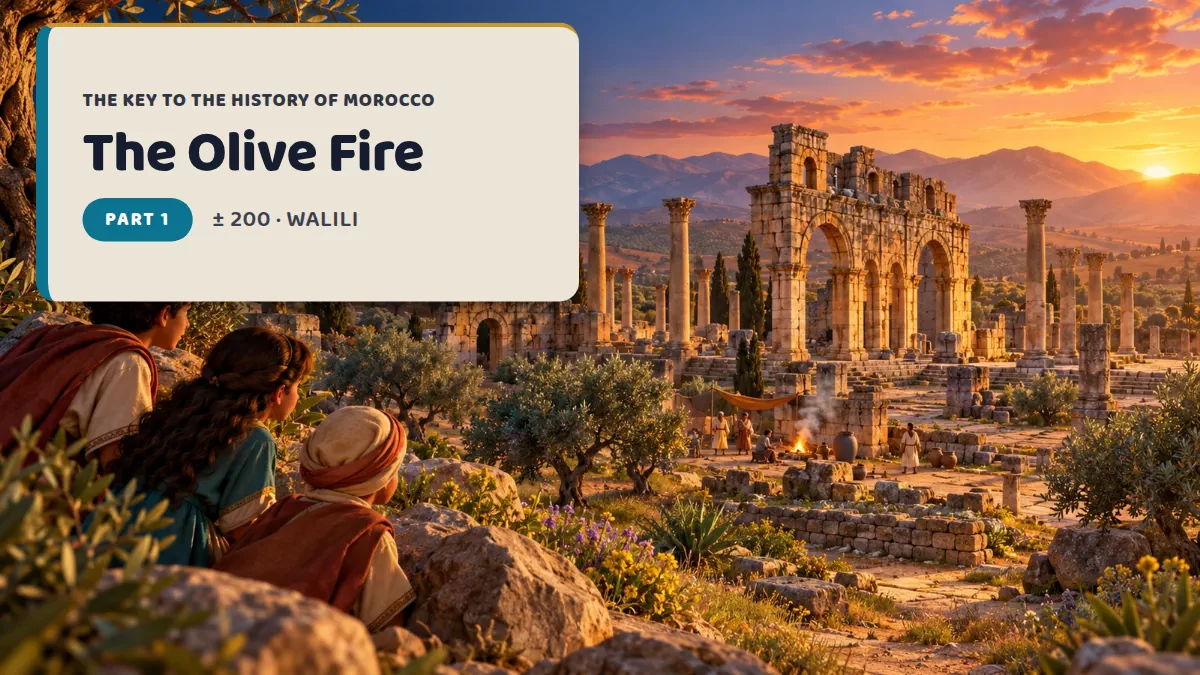
The Olive Fire
± 200 · Walili (Volubilis), at the foot of the Zerhoun
Tala holds the key to the storehouse and the overseer wants it. When the whole city’s oil is at risk, she has to choose between obeying and being right.
Told by Tala, eleven, daughter of an oil-press owner who has fallen ill
What really happened
Volubilis — Walili in Arabic — was a real Roman city near Meknès, with thousands of inhabitants, bathhouses and stone streets.
The city lived on olive oil. Dozens of presses have been excavated, and they worked on the same principle as the presses still used in Morocco today.
The floors were covered in mosaic. Part of it is still there, in the open air.
The population was largely Amazigh; Roman and Amazigh life ran through one another here.
What is made up
Tala, her family and the overseer Marcus did not exist.
The fire in the story is made up. There is no evidence of a great fire at Walili in this period.
The key with the eight-pointed star is made up. The eight-pointed khatam is a real and very old Moroccan motif.
The key The key is forged in Walili by Tala’s grandfather and leaves at the end with an Amazigh caravan into the hills.
Book 2
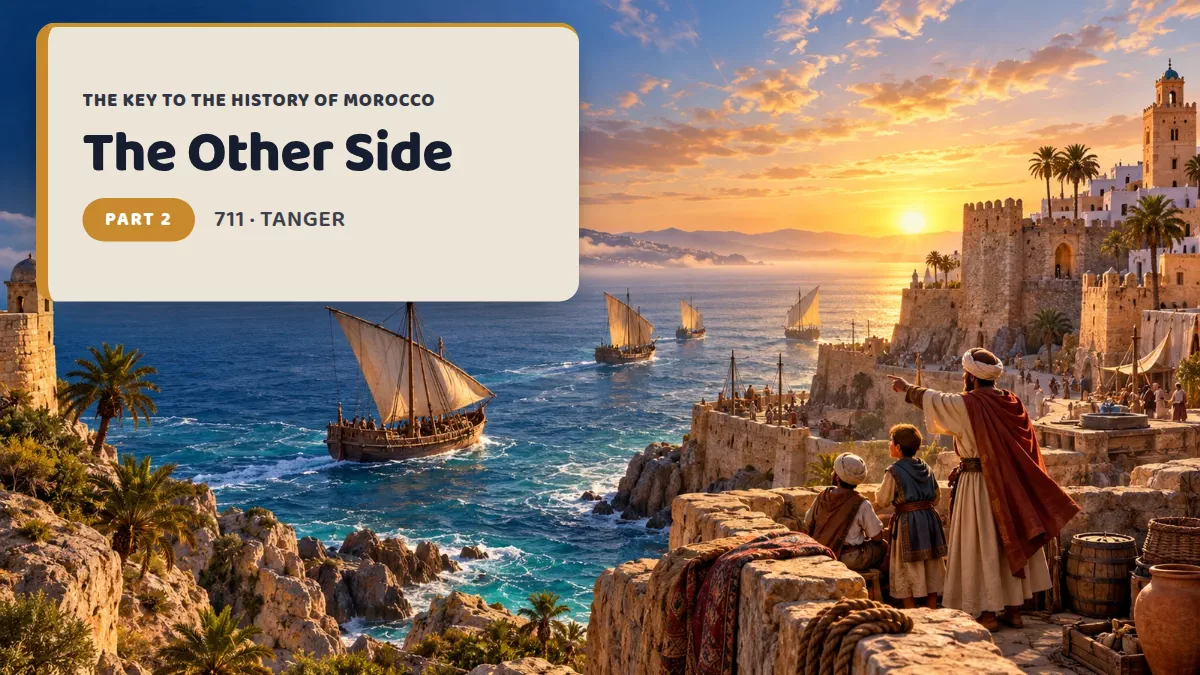
The Other Side
711 · Tangier, and the strait to the north
An army crosses to a land nobody knows. Ayyur is allowed to come along to care for the horses — and discovers that the man everyone follows is frightened too.
Told by Ayyur, twelve, a shepherd’s son who looks after the horses
What really happened
Tariq ibn Ziyad was an Amazigh commander who crossed the strait in 711 with an army to the south of present-day Spain.
The rock where he landed still bears his name: Jabal Tariq, the mountain of Tariq — worn down into Gibraltar.
Most of his army consisted of Amazigh soldiers from North Africa.
The story that he had his ships burned was written down only centuries later and is not regarded by historians as fact.
What is made up
Ayyur and his family did not exist.
The conversations with Tariq are made up. Almost nothing is known about his character.
That the key travelled along is made up.
The key The key hangs from a horse’s harness and stays behind on the other side, in a scribe’s bag.
Book 3
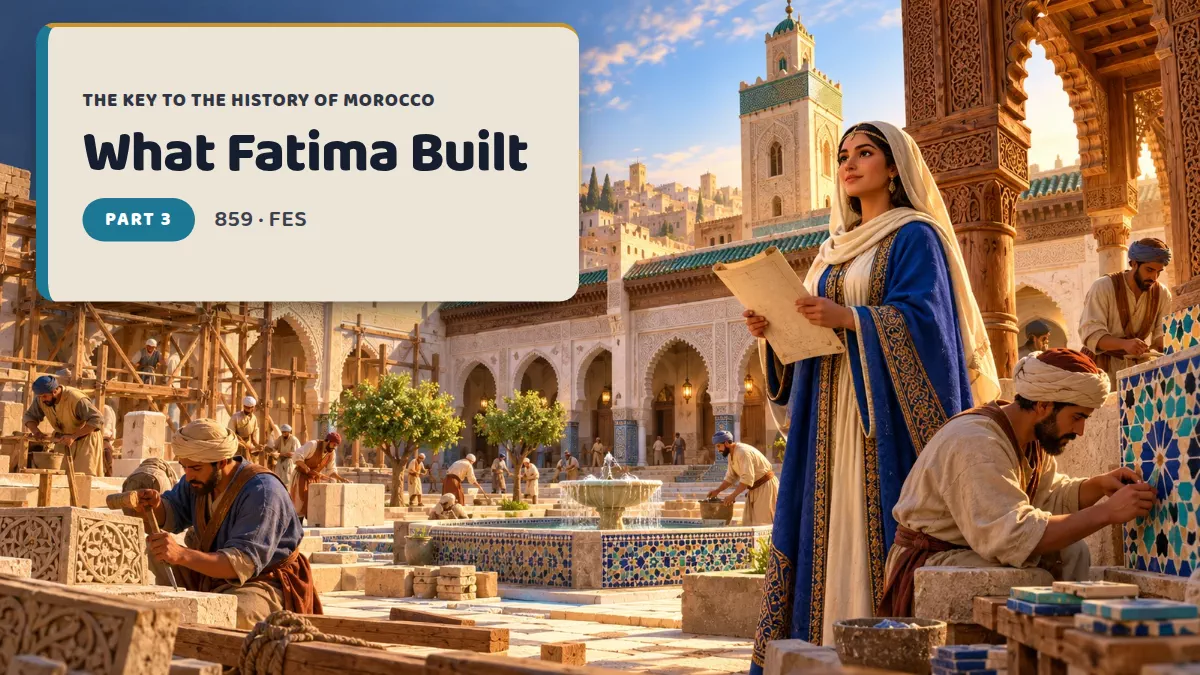
What Fatima Built
859 · Fez, on the bank of the river
A woman spends her entire inheritance on a building nobody can see the point of. Hind carries the water, counts the stones — and is the first to understand what it is meant to become.
Told by Hind, thirteen, an orphan who carries water for the masons
What really happened
Fatima al-Fihri founded the al-Qarawiyyin in Fez in 859: a mosque that grew into a place of learning.
That institution is regarded as the oldest university still working in the world and is listed as such in the Guinness Book of Records and by UNESCO.
She paid for the building out of the inheritance of her father, a merchant from Kairouan in present-day Tunisia.
Her sister Maryam founded the al-Andalusiyyin mosque in the same city. That one is still standing too.
Fez then consisted of two separate cities on either side of the river: a quarter of people from Kairouan and a quarter of people from Andalusia. The two sisters’ mosques each stand on one side.
Fez itself had been founded shortly before, under Idris I and his son Idris II.
The al-Qarawiyyin has never closed since 859. There is no known year in which no teaching took place.
What is made up
Hind did not exist. Nor did Driss the mason, aunt Rahma and the boy by the rooms.
Little is known about daily life on the building site; that has been filled in with what we know of other buildings from that time.
The scene in which Fatima talks with Hind is made up, and so is the one in which she shovels mud alongside them.
That Fatima fasted for as long as the building lasted is a tradition. It is not certain that it happened, and for that reason the book tells it as something that is told.
That the money ran out halfway and that the city took over the work is made up. How the building was actually paid for we do not know.
The key The key goes into the foundation, and is taken out again years later during building work.
Book 4
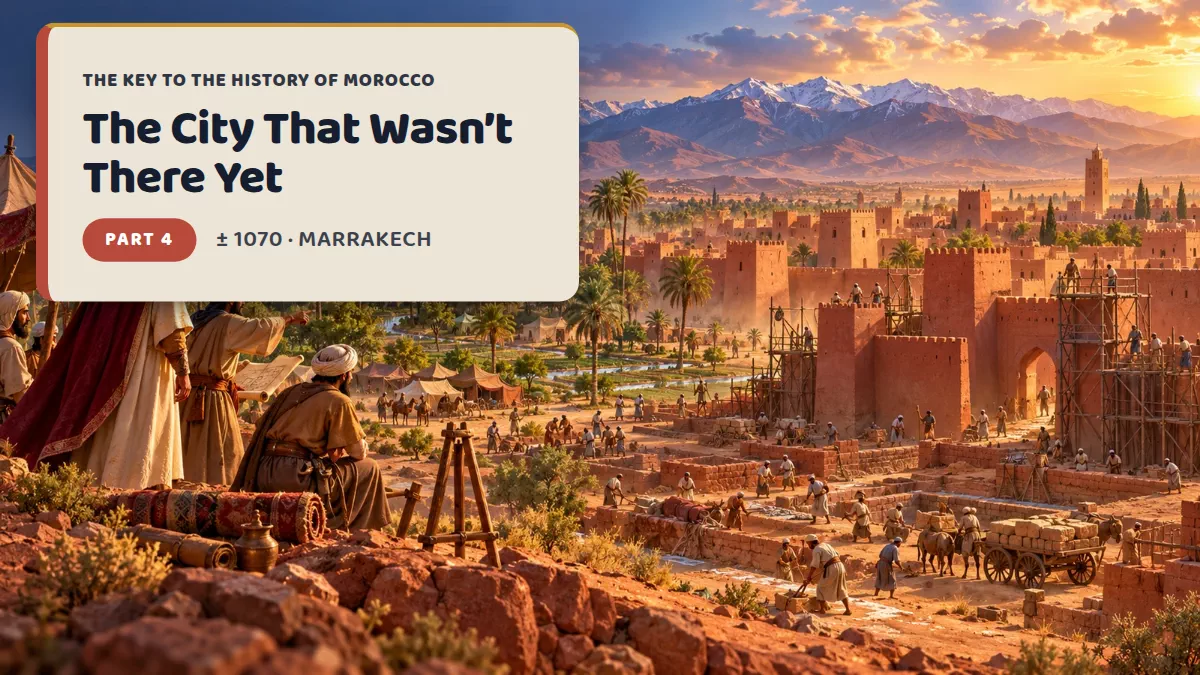
The City That Wasn’t There Yet
± 1070 · The plain where Marrakesh is being built
A city is being stamped out of the ground in a place where there is nothing. Isli brings the stones, and hears from the woman who runs everything why it has to be here.
Told by Isli, twelve, a camel driver from the south
What really happened
Marrakesh was founded around 1070 by the Almoravids, under Yusuf ibn Tashfin.
The country is named after this city: Marrakesh became Morocco in European languages.
Zaynab an-Nafzawiyya was the wife of Yusuf ibn Tashfin and had great influence on the government; medieval chroniclers name her explicitly.
The Almoravids built the underground irrigation system — the khettara — that supplied the city with water. Parts of it are still there.
There was already a city right next to Marrakesh: Aghmat, against the mountains. It was abandoned for the new city on the plain. Aghmat is now being excavated.
The city wall is of rammed earth (tabia) and is more than nineteen kilometres long. The soil there is red, and that is why the city is red.
Marrakesh lay at the crossing of the caravan roads. From the south came gold from the empire of Ghana and the region of present-day Mali; salt went the other way.
What is made up
Isli, his uncle, the camel Tamghart and the digger Brahim did not exist.
The conversations with Zaynab are made up; what she actually said has not come down to us.
The collapse of the seventh shaft is made up. That it was dangerous work is not: many people have died digging khettaras over the centuries.
How the first market came about we do not know. That cities start that way, we do.
The key The key travels in a saddlebag and stays behind in the wall of the first city gate.
Book 5
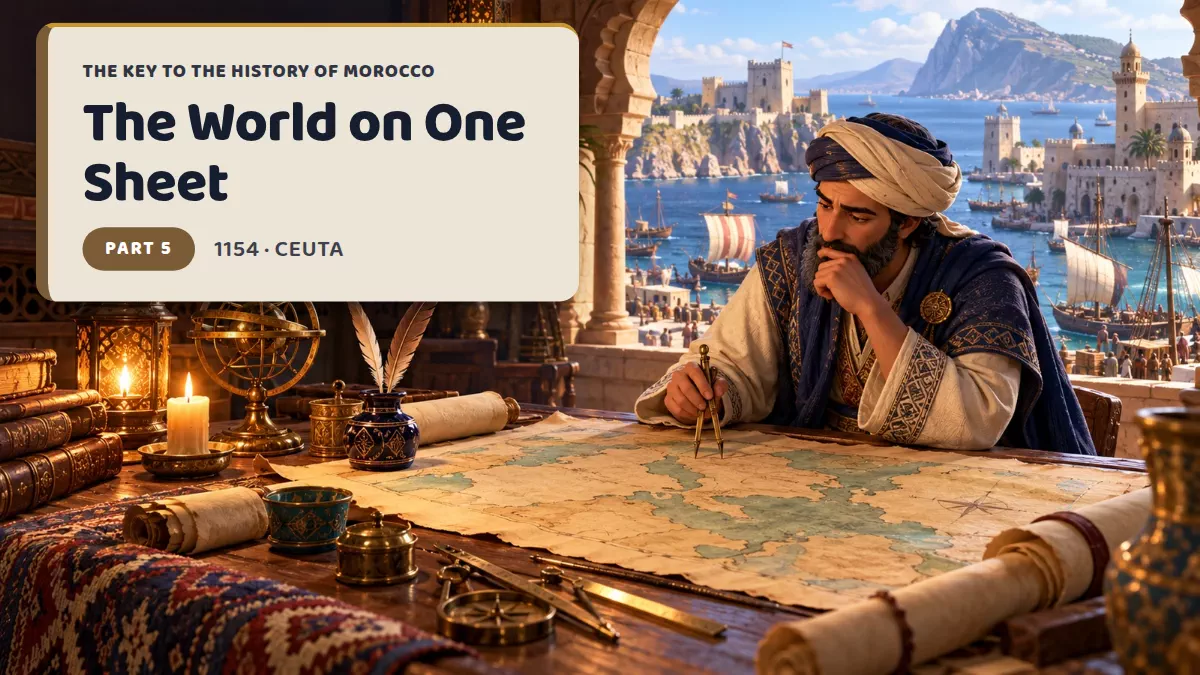
The World on One Sheet
1154 · Ceuta, and the court of King Roger in Sicily
A scholar from Ceuta draws a map of the whole world for a Christian king. Sanaa grinds his ink — and discovers that a map is more dangerous than a sword.
Told by Sanaa, fourteen, daughter of a mapmaker
What really happened
Muhammad al-Idrisi was born around 1100 in Ceuta and worked at the court of King Roger II of Sicily.
In 1154 he completed the Tabula Rogeriana: a world map with an extensive book of geography alongside it.
His map was for centuries the most accurate of the known world, and was used in Europe well into the sixteenth century.
On the map the south is at the top — that is how maps were drawn in the Islamic world at the time.
The map consists of seventy sheets: seven climate zones from south to north, each in ten pieces from west to east.
Al-Idrisi worked by questioning travellers and comparing their answers with one another. What only one man said, he did not take.
A silver version was also made, of several hundred pounds. It disappeared after the death of Roger II and was almost certainly melted down.
In Sicily under Roger II government was conducted in three languages: Arabic, Greek and Latin. His coins carry Arabic and Latin.
The book that goes with the map is called Nuzhat al-mushtaq: the pleasure of him who longs to cross the horizon.
What is made up
Sanaa and her father did not exist.
The intrigues at court in the story are made up, although the court of Roger II really was a place where Muslims, Christians and Jews worked together.
The captain who contradicts the bend in the coast is made up. That al-Idrisi corrected older maps with what sailors told him is not.
That al-Idrisi was reproached by fellow believers for working for a Christian king has come down to us; the conversations about it in this book are made up.
The key The key is used as a weight on a parchment and travels back with them to North Africa.
Book 6
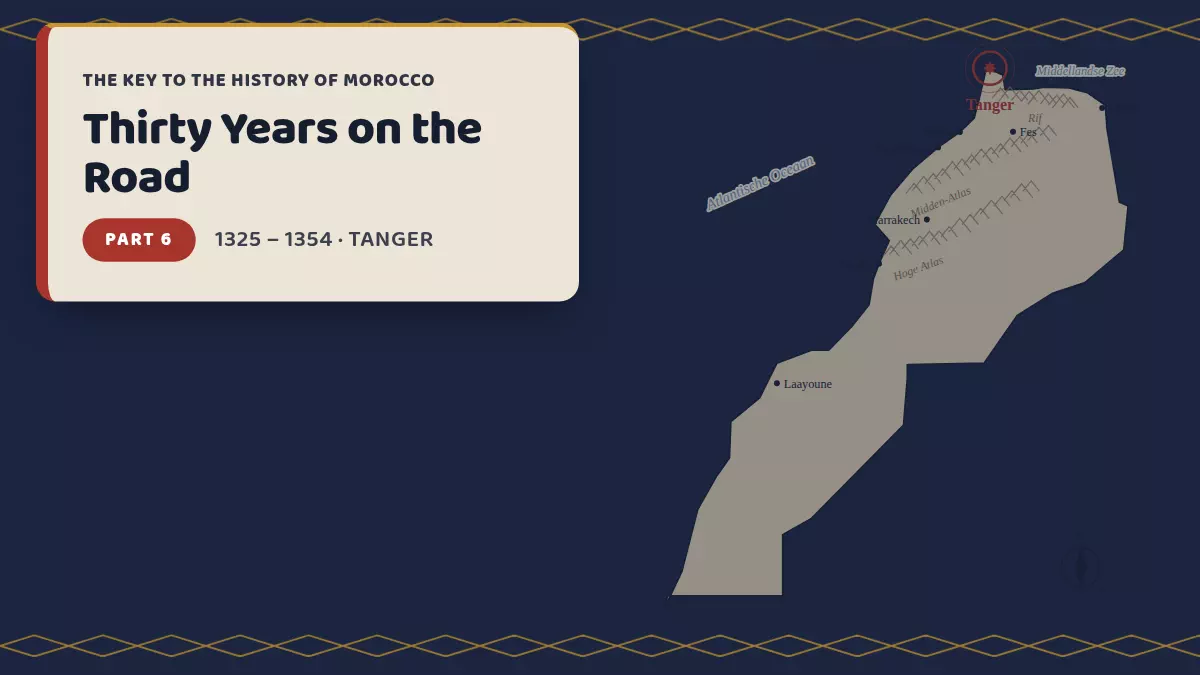
Thirty Years on the Road
1325 – 1354 · From Tangier to Mecca, India, China and back
A young man from Tangier sets out on pilgrimage and comes back thirty years later. Musa writes down what he sees — and realises that his master does not tell all of it the way it happened.
Told by Musa, thirteen, a scribe’s apprentice travelling as a helper
What really happened
Ibn Battuta left Tangier in 1325, aged twenty-one, for the pilgrimage to Mecca.
He travelled for almost thirty years and covered, by most estimates, more than a hundred and twenty thousand kilometres — far more than Marco Polo.
He visited, among other places, Egypt, Persia, India, the Maldives, possibly China, and the empire of Mali.
Back in Morocco he dictated his story to the scribe Ibn Juzayy; that book is called the Rihla.
Some parts of the Rihla are probably copied from other travel accounts; this has been argued about for centuries. About China above all, scholars do not agree.
In Delhi he was a judge for eight years under Sultan Muhammad ibn Tughluq, as generous as he was dangerous. Ibn Battuta fell out of favour and withdrew with an ascetic outside the city.
He was then sent to China as an ambassador. That embassy was attacked on the road and the fleet was lost off the coast of India.
In the Maldives he was a judge again and married into the ruling family.
In 1348 he passed through Damascus during the Black Death. His description is one of the few eyewitness accounts we have of the plague in the Middle East, including the joint procession of Muslims, Christians and Jews outside the walls.
His mother died of that same plague shortly before he came home.
The lighthouse of Alexandria, one of the seven wonders of the ancient world, was still half standing on his first visit and had collapsed in earthquakes by his second.
What is made up
Musa did not exist. The real scribe was Ibn Juzayy, and he was not a child.
The five chests, the chest that goes overboard and the notes Musa rewrites from memory are made up.
The order of some journeys is simplified, because the Rihla itself does not add up in places.
The conversations are made up, including the one about China — but the doubt in it is real and shared by scholars.
The key The key goes half way round the world in a travelling chest and comes back with Ibn Battuta to Fez.
Book 7
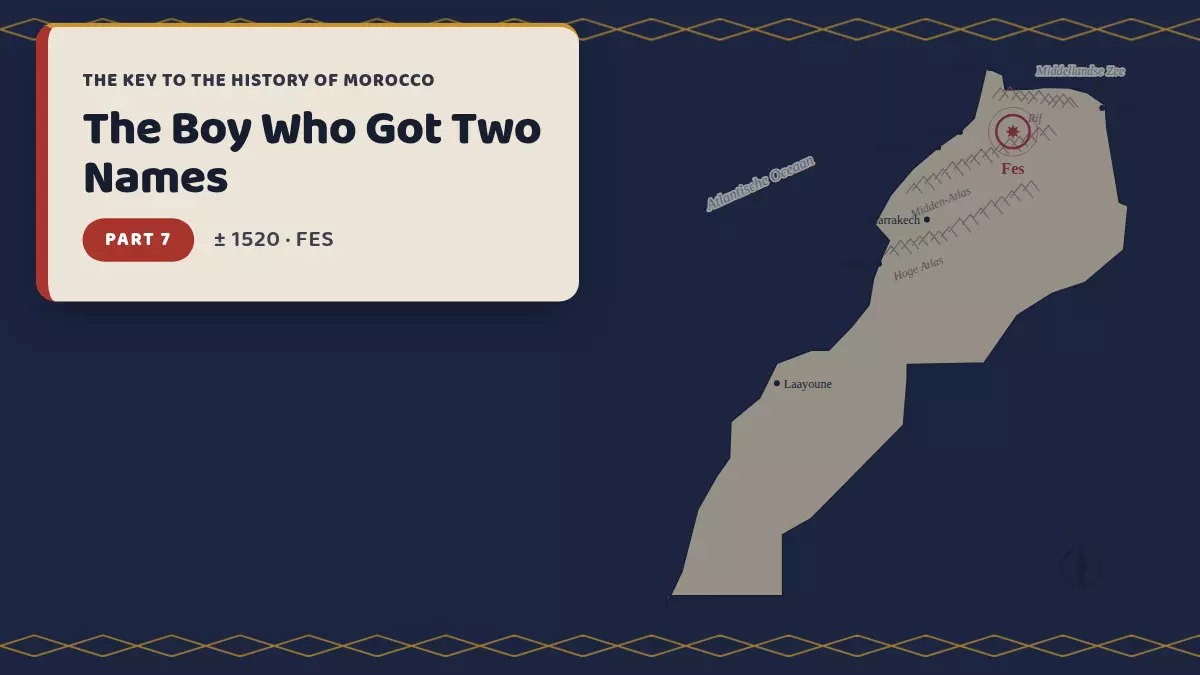
The Boy Who Got Two Names
± 1520 · Fez, the Mediterranean, and Rome
A young diplomat from Fez is captured at sea and given to the pope. He gets a new name, a new faith and a new language — and writes the book through which Europe came to know Africa.
Told by Hassan, fifteen, a diplomat’s son from Fez
What really happened
Al-Hassan ibn Muhammad al-Wazzan was born around 1494 in Granada and grew up in Fez.
He travelled as an envoy through North Africa and was captured by pirates around 1518 and presented to Pope Leo X.
He was baptised as Johannes Leo de Medici and is known as Leo Africanus.
His book “Description of Africa” (1526) was for centuries the most important European source on North Africa.
As a boy he worked for two years as a scribe in the maristan of Fez, the hospital where the mentally ill were also cared for.
He travelled with the caravan to Timbuktu and described on the way Taghaza, the salt mine in the Sahara where the houses are built of slabs of salt.
About Timbuktu he wrote that more was earned from books than from any other merchandise. For centuries Europe did not believe it; since the 1980s hundreds of thousands of manuscripts from the city and its region have come to light.
He was baptised on 6 January 1520 in St Peter’s, with Pope Leo X as his godfather.
In Italy he taught Arabic and worked with the Jewish physician Jacob Mantino — also driven out of Spain — on an Arabic-Hebrew-Latin dictionary. It was never finished.
He wrote his book in Italian, a language he had known only a few years. In the oldest manuscript his own, un-Italian turns of phrase are still visible; later editors polished them away.
In 1527 Rome was sacked by unpaid mercenaries. After that he appears in no document at all.
He probably returned later to North Africa; little is certain about his last years.
What is made up
The conversations and his inner world are made up. What he really thought about his forced conversion we do not know — he left not a single line about it.
The three explanations of his baptism stand there as possibilities, not as fact. The fable of the bird that can be a fish really is in his book, and he writes himself that he is that bird.
That he corrected errors in the margins of geography books in Castel Sant’Angelo is made up.
The key in the book cover is made up.
The key The key is hidden in Rome inside the cover of a book and returns years later with that book to Tunis.
Book 8
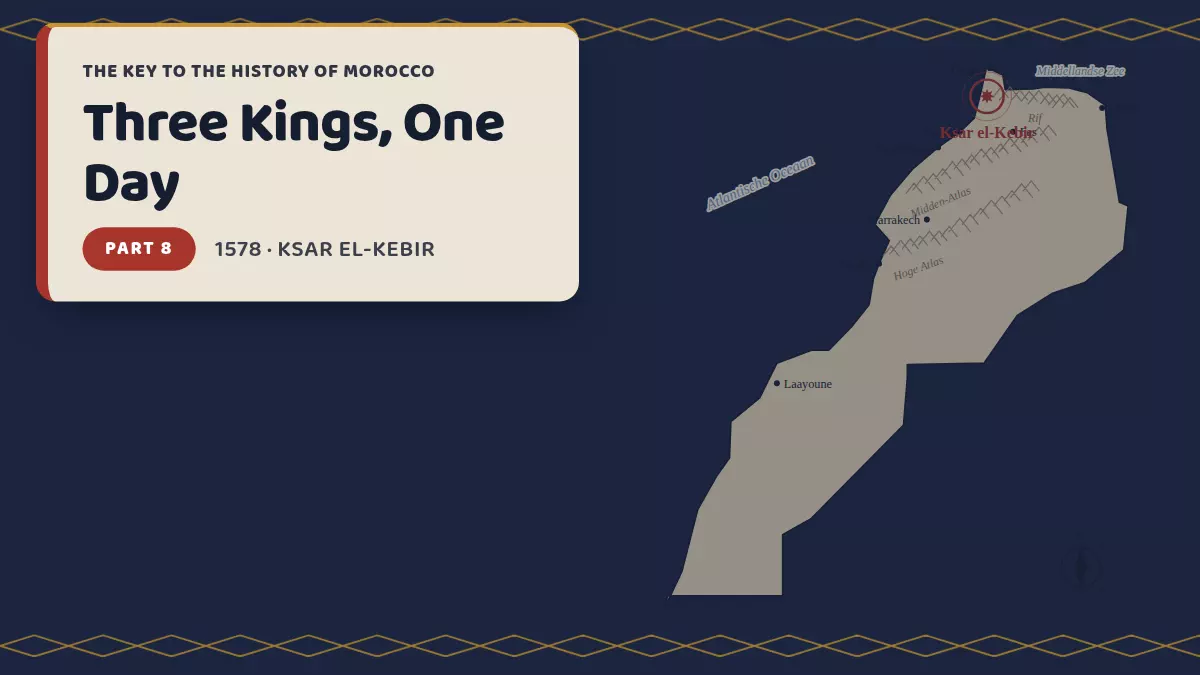
Three Kings, One Day
1578 · Near Ksar el-Kebir, on the river Loukkos
In a single day three kings die in the same battle. Driss beats the drum, watches it happen, and only later understands what the country gains and loses by it.
Told by Driss, fourteen, a drummer in the army
What really happened
The Battle of the Three Kings (also: the Battle of Ksar el-Kebir, or Alcácer Quibir) took place on 4 August 1578.
Three kings died: the Portuguese king Sebastian, the deposed sultan Abu Abdallah Mohammed and the reigning sultan Abd al-Malik.
Portugal lost its king there and shortly afterwards lost its independence to Spain.
The new sultan was Ahmad al-Mansur, the brother of Abd al-Malik.
Sebastian was twenty-four and had no child. His advisers had warned him against the campaign; his uncle the cardinal succeeded him and died two years later, after which Philip II of Spain claimed the Portuguese throne.
Abd al-Malik had been ill for weeks and commanded from a litter. His death halfway through the battle was kept from the army.
In Portugal it was believed for centuries afterwards that Sebastian was still alive and would return. That belief has a name: Sebastianism.
Thousands of Portuguese nobles were taken prisoner and ransomed. That money flowed to Morocco and helped pay for the government of Ahmad al-Mansur and the building of the Badi palace.
What is made up
Driss, Aziz and the Portuguese boy at the stream did not exist.
The twenty-seven drum signals are made up. That armies were directed with drums because a voice does not carry far enough is not.
The course of the battle is simplified; eyewitnesses contradict one another on many points.
This book is about a battle and people die. It is written for readers of eleven and up, and what happened on the field itself is deliberately not in it.
The key The key is lost on the battlefield and found by a soldier marching to Marrakesh.
Book 9
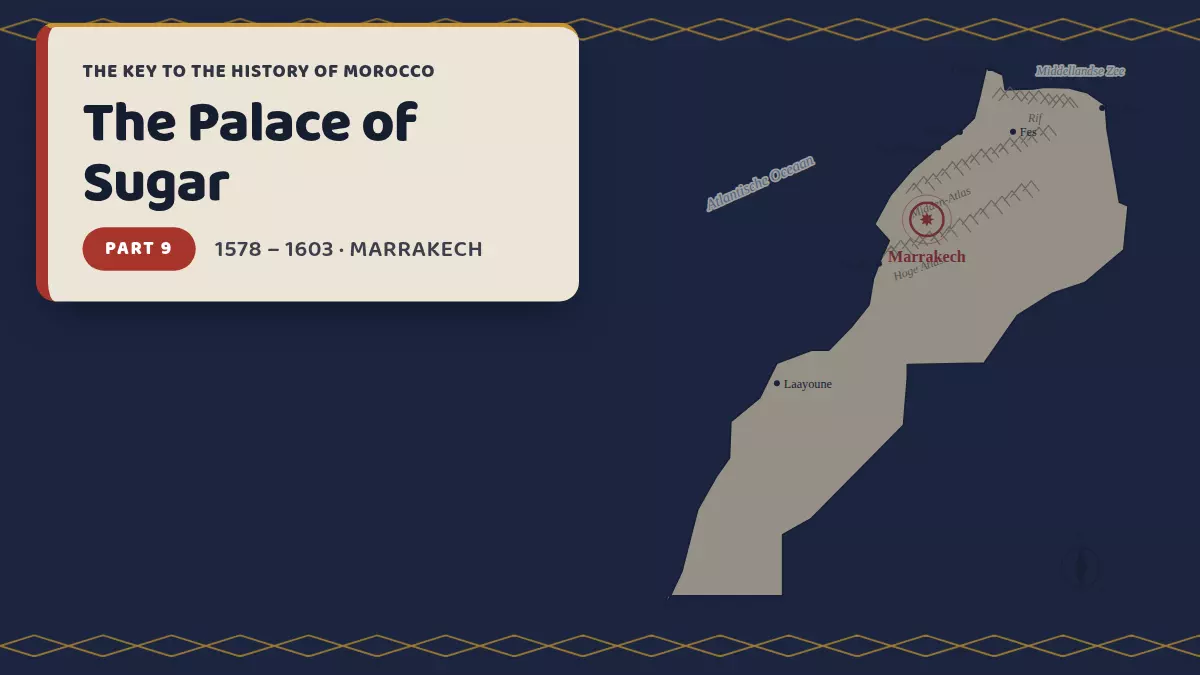
The Palace of Sugar
1578 – 1603 · Marrakesh, the Badi palace
A sultan builds the finest palace of his time and pays for it with sugar and with gold from the desert. Lalla lays the tiles — and hears where that gold comes from.
Told by Lalla, twelve, daughter of a tile-setter
What really happened
From 1578 Ahmad al-Mansur had the Badi palace built in Marrakesh. “El Badi” means: the incomparable.
It was paid for out of the sugar trade and out of gold, among other things after the campaign against the Songhai empire in 1591.
Marble from Italy was used, said to have been paid for with sugar of equal weight.
Around 1700 Sultan Moulay Ismail had the palace demolished in order to build Meknès. What is left is a ruin you can still visit.
The campaign against Songhai brought wealth to Morocco and at the same time destroyed one of the greatest empires of West Africa, including the city of Timbuktu.
At Tondibi in 1591 a Moroccan army with firearms defeated a far larger Songhai army without them. About half the Moroccan soldiers did not survive the desert crossing.
The scholar Ahmad Baba was taken from Timbuktu to Marrakesh. His library of sixteen hundred books was confiscated; by his own account it was the smallest collection in his family. He taught for years in Marrakesh and later returned.
The sugar came from cane fields in the Souss, processed in water mills. The work was largely forced labour and a great deal of forest was cut down for it.
Ahmad al-Mansur exchanged embassies with Queen Elizabeth I of England. His envoy Abd el-Ouahed ben Messaoud was in London in 1600; the portrait painted of him there still exists.
Al-Mansur died in 1603 of the plague. His three sons then fought over the throne for years and the empire fell apart.
Moulay Ismail had the palace demolished around 1700 and the material taken to Meknès. What stands there is what was not worth transporting.
What is made up
Lalla, her father and her children did not exist.
Al-Mansur’s words in this book are made up, and the story of the jester who said it would make a fine ruin was probably invented later.
That Shakespeare saw the Moroccan embassy in London and that Othello came out of it has been said for centuries but has never been proved. That is why it stands here as something that is said.
The key The key is walled into the palace and comes free when the palace is pulled down.
Book 10
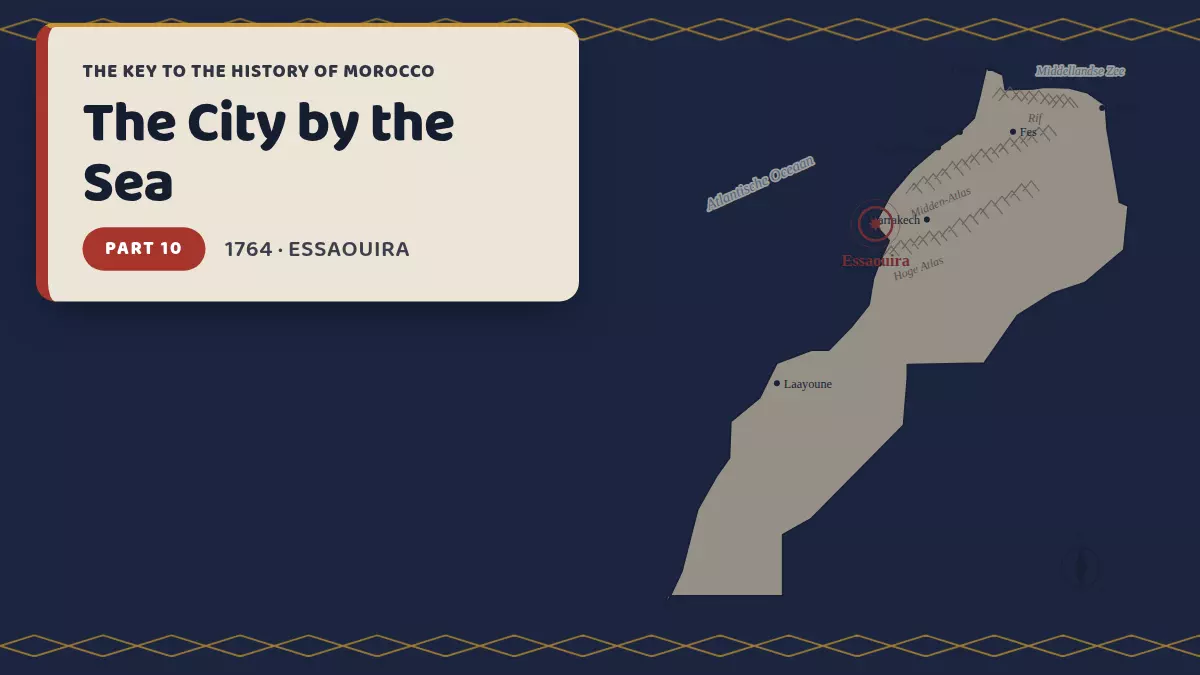
The City by the Sea
1764 · Essaouira, which has yet to be built
A sultan has a harbour city built on a windy spot where nobody lives, and asks a French architect to draw it. Yto watches her beach turn into a city with straight streets.
Told by Yto, thirteen, a fisherman’s daughter
What really happened
Sultan Mohammed ben Abdallah had the harbour city of Essaouira (Mogador) laid out from 1764.
The design with the straight streets and the fortifications was made with the help of European engineers, among them the Frenchman Théodore Cornut.
The city was opened to trade with Europe and had a large Jewish community that played a key part in that trade.
The name Essaouira is usually explained as “the little wall” or “the well drawn”.
On the island off the coast, purple dye was made from sea snails as far back as antiquity. The remains of those workshops have been excavated.
The city has a rectangular street plan, unlike the grown medinas of Fez and Marrakesh. That made it easy to survey and to defend.
The sultan brought Jewish merchant families to the city and gave a number of them the right to trade on his behalf: the tujjar as-sultan, the sultan’s merchants. At its height a large part of the population was Jewish.
Almost all of that community left in the twentieth century. The synagogues and the cemetery are still there.
What is made up
Yto, her father, Esther and the clerk Abdeslam did not exist.
The meeting with the architect is made up, and so is his answer “cannon” — although that is what made a rectangular plan valuable at the time.
The storm of the seventh year is made up.
The key The key is found in the sand and goes aboard a ship bound for America.
Book 11
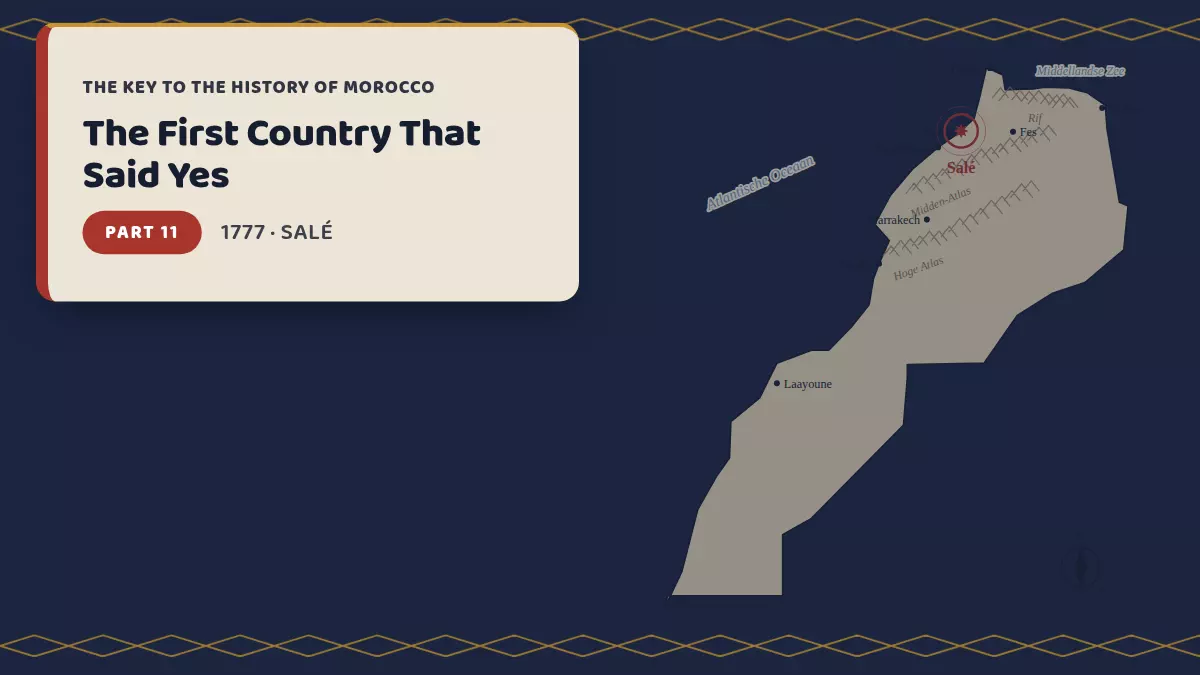
The First Country That Said Yes
1777 · Tangier, Salé, and a ship to the other side
A young country on the other side of the ocean asks to be recognised, and Morocco is the first to answer. Brahim copies out the letters — and understands that a signature sometimes weighs more than an army.
Told by Brahim, fourteen, assistant to a harbour scribe
What really happened
In 1777 Sultan Mohammed ben Abdallah declared that American ships were free to use Moroccan ports.
Morocco is therefore regarded as one of the first countries to recognise the United States.
In 1786 came the Moroccan-American treaty of friendship, which is still in force: it is the oldest unbroken treaty of the United States.
The American consulate in Tangier, given by the sultan, is the oldest American government building outside the United States. It is now a museum.
The 1786 treaty was negotiated by Thomas Barclay. Unlike the other states on that coast, Morocco asked for no annual payment.
The treaty says that the crew of a wrecked ship shall be helped and that nothing shall be taken from them. At the time that was anything but obvious.
In 1789 George Washington wrote to the sultan. That letter begins with “Great and magnanimous friend” and still exists.
There were corsairs on both sides of the Mediterranean: from Salé, Algiers, Tunis and Tripoli, but also from Malta, Livorno and Spain. A corsair carried papers from a ruler stating which ships he was allowed to take.
In the ports of the Mediterranean a mixed language was spoken for centuries — the lingua franca — made of Italian, Spanish, Arabic and Portuguese words, without conjugations.
What is made up
Brahim and the harbour scribe Si Lhabib did not exist.
The content of the conversations about the treaty is made up.
The letters from captured crews that Brahim copies out are made up; that such letters were written in their thousands is not.
The key The key travels in a chest of documents and stays behind in the consulate in Tangier.
Book 12
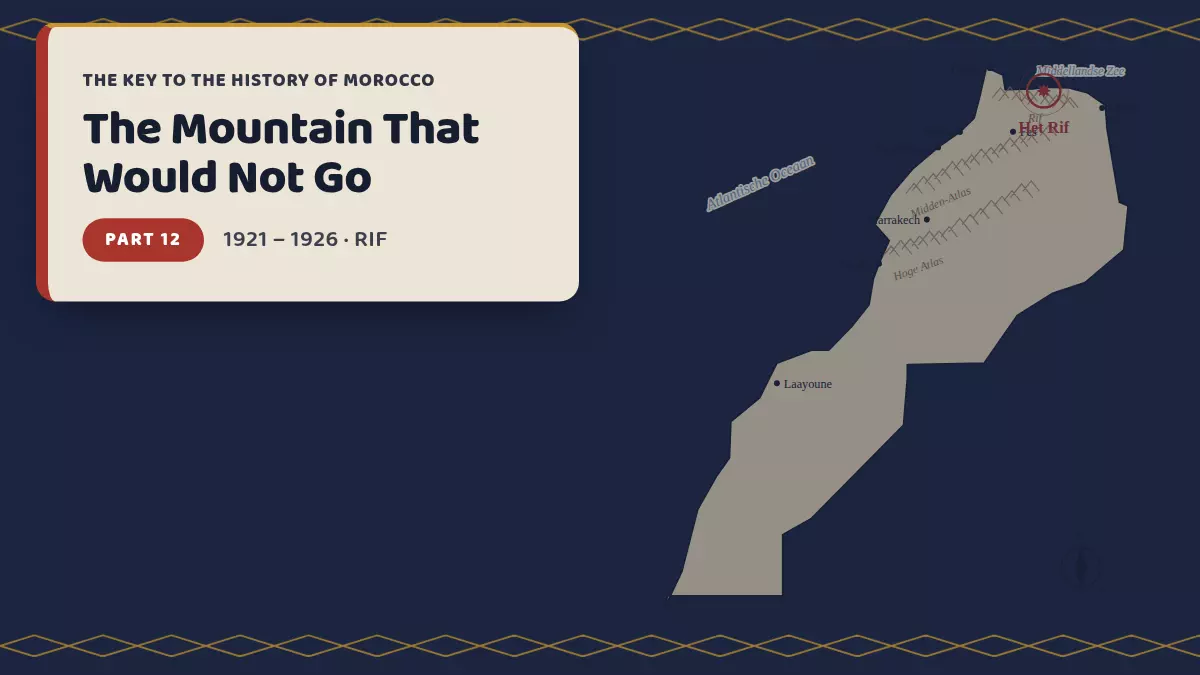
The Mountain That Would Not Go
1921 – 1926 · The Rif mountains
In the mountains of the Rif a community stands up to two great armies at once. Itto carries messages between the villages — and learns what happens to a story when the winners write it down.
Told by Itto, fifteen, daughter of a village teacher
What really happened
Between 1921 and 1926 the Rif Republic under Abd el-Krim fought against Spain and later also against France.
In 1921 the Spanish army suffered a heavy defeat at Annual.
Chemical weapons were used in this war against the population of the Rif. Spain denied it for a long time.
Morocco was at that time under French and Spanish protectorate, since 1912.
Abd el-Krim studied at the al-Qarawiyyin in Fez, was a judge in Spanish service in Melilla and wrote for a Spanish newspaper. In 1915 he was imprisoned by Spain; trying to escape through a window he broke his leg and walked with a limp ever after.
The Rif Republic had a council, judges not tied to one tribe, tax collection and schools. Almost no archive of it has survived.
After his surrender Abd el-Krim was exiled to the island of Réunion, where he lived for twenty-one years. In 1947 he went ashore at Port Said and stayed in Egypt; he died in 1963 in Cairo.
The language of the Rif is Tarifit, an Amazigh language. Tamazight has only become an official language of Morocco in this century.
What is made up
Itto and her family did not exist.
This book is about a war. It is written for readers of twelve and up and keeps the violence out of view, but the violence is there.
What Itto saw of the gas attacks is not in it. That is a choice: she never told it at length herself, and then it is not for a writer to fill it in for her.
The key The key travels in a messenger’s bag and is buried under a floor when the village is cleared.
Book 13
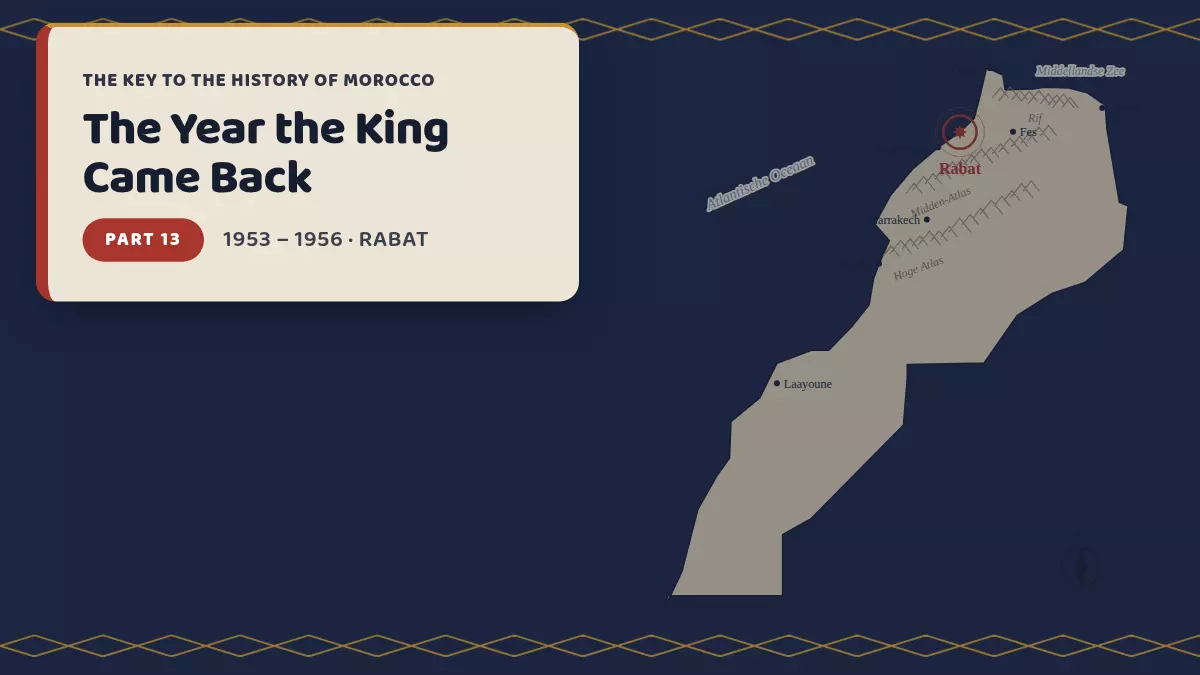
The Year the King Came Back
1953 – 1956 · Rabat, Casablanca, and an island far away
The king is sent out of the country and the people rise. In her father’s printing shop Nadia sees how dangerous a pile of paper can be.
Told by Nadia, fourteen, daughter of a printer
What really happened
In 1953 Sultan Mohammed V was deposed and exiled by the French authorities, first to Corsica and then to Madagascar.
His exile led to great unrest and resistance throughout the country.
In November 1955 he returned; on 2 March 1956 Morocco became independent from France, shortly followed by the Spanish zone.
The resistance was carried by very different groups: city parties, trade unions, and armed groups in the countryside.
In January 1944 the Manifesto of Independence was signed. Of the sixty-six signatories Malika El Fassi was the only woman; she worked all her life for the education of girls.
Boycotting French products, above all the tobacco of the state monopoly, was one of the most effective means of the resistance.
From Cairo the Voice of the Arabs broadcast, receivable in those years throughout North Africa.
In the years the sultan was in exile, many people said they saw his face in the full moon. It happened all over the country.
What is made up
Nadia and her father did not exist.
The pamphlets in the story are made up, although underground printing in these years certainly existed.
The eleven days her father was held are made up. That people were arrested without their families knowing where they were is not.
The key The key is inside a false book in which pamphlets are hidden, and stays behind in Casablanca.
Book 14
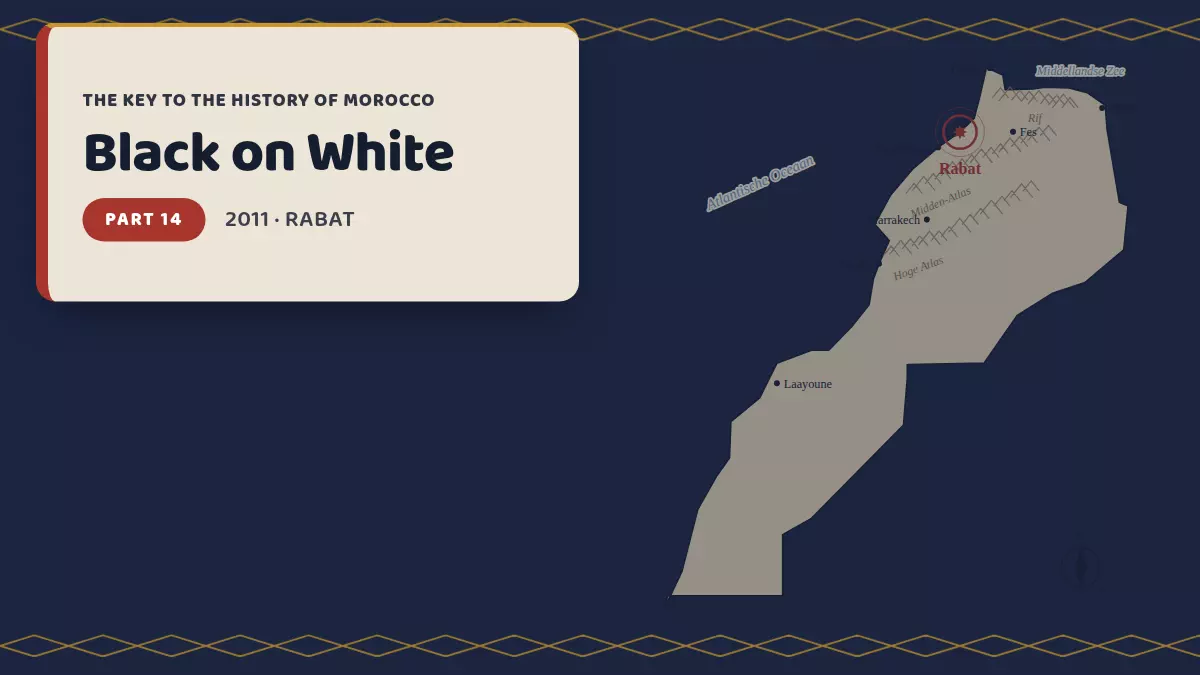
Black on White
2011 · Rabat, and a village in the High Atlas
A language everyone speaks but nobody is allowed to write down finally gets a place. Anir teaches his grandmother to write her own name in an alphabet older than Rome.
Told by Anir, twelve, grandson of a woman who cannot read
What really happened
In 2011 Tamazight was included in the Moroccan constitution as an official language, alongside Arabic.
Tamazight is written in the Tifinagh alphabet, which goes back to a script used in North Africa for more than two thousand years.
The Royal Institute of Amazigh Culture (IRCAM) was founded in 2001 and established the current spelling.
In practice it took years before the law was carried out; in 2019 this was regulated further.
For a long time there was a list of permitted first names on which Amazigh names did not appear. Parents were turned away at the registry office because of it. That restriction was only dropped in this century.
The 2011 constitution came about in the year of demonstrations across the whole region. In Morocco those protests began in February; in July the new constitution was voted on.
Among the Tuareg of the Sahara Tifinagh never fell out of use. The version now used in schools was newly established, with signs for sounds the old version did not have.
What is made up
Anir and his grandmother did not exist.
The village in the story is made up, but resembles villages that really exist.
The rock inscription two valleys away is made up. Such inscriptions really do exist in many places in North Africa.
The key The key lies in a copper box in the village, among things nobody can place any more.
Book 15
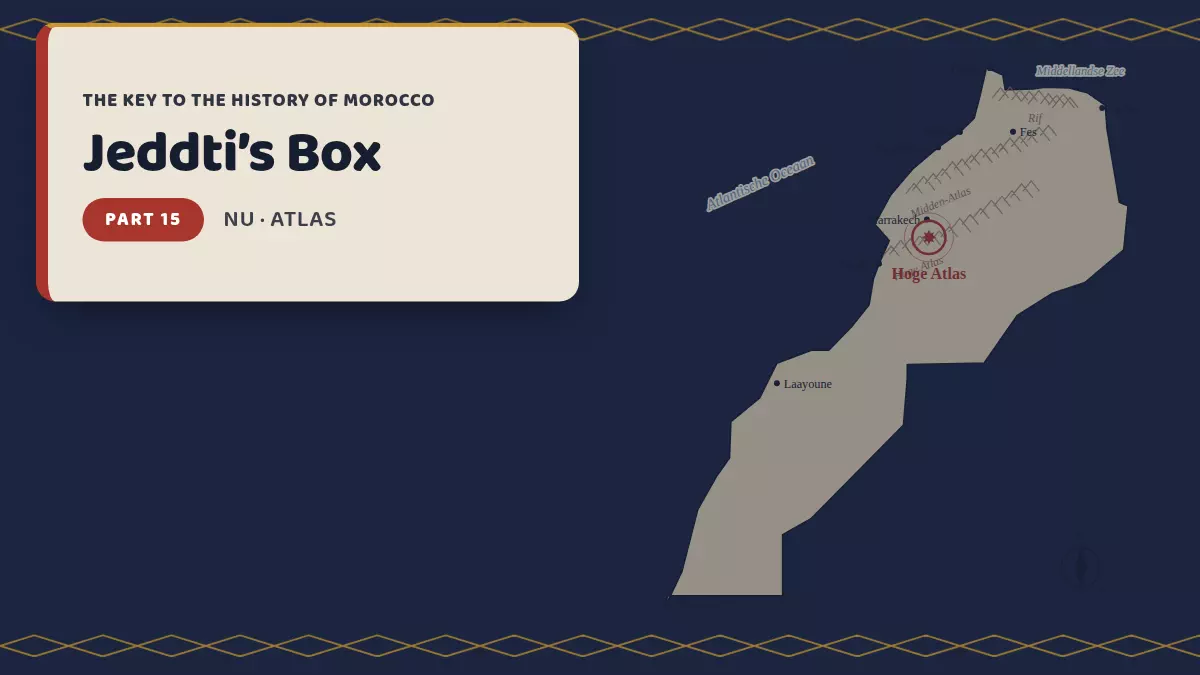
Jeddti’s Box
Now · Utrecht, and a village in the High Atlas
Adil has to go to Morocco and does not want to. In his grandmother’s cupboard he finds a key that fits no door — and a journey of two thousand years arrives at him.
Told by Adil, thirteen, born in the Netherlands
What really happened
The fourteen books before this one take place around events that really happened.
About five million people of Moroccan origin live outside Morocco, most of them in Europe.
Many families keep objects from a house where nobody lives any more. Keys of abandoned houses are a well-known example.
What is made up
Adil and his family are made up — though he will seem familiar to many readers.
The key itself is made up from beginning to end. It was invented to tie two thousand years together, and that is exactly what a story is allowed to do.
The key The key comes to Adil. He is the fifteenth and the last, and what he does with it is up to him.
The Olive Fire — the first three chapters as a PDF, no account and no email address.Or as a pdf
One message as soon as a new part is out. No ads, and unsubscribing takes one click.